
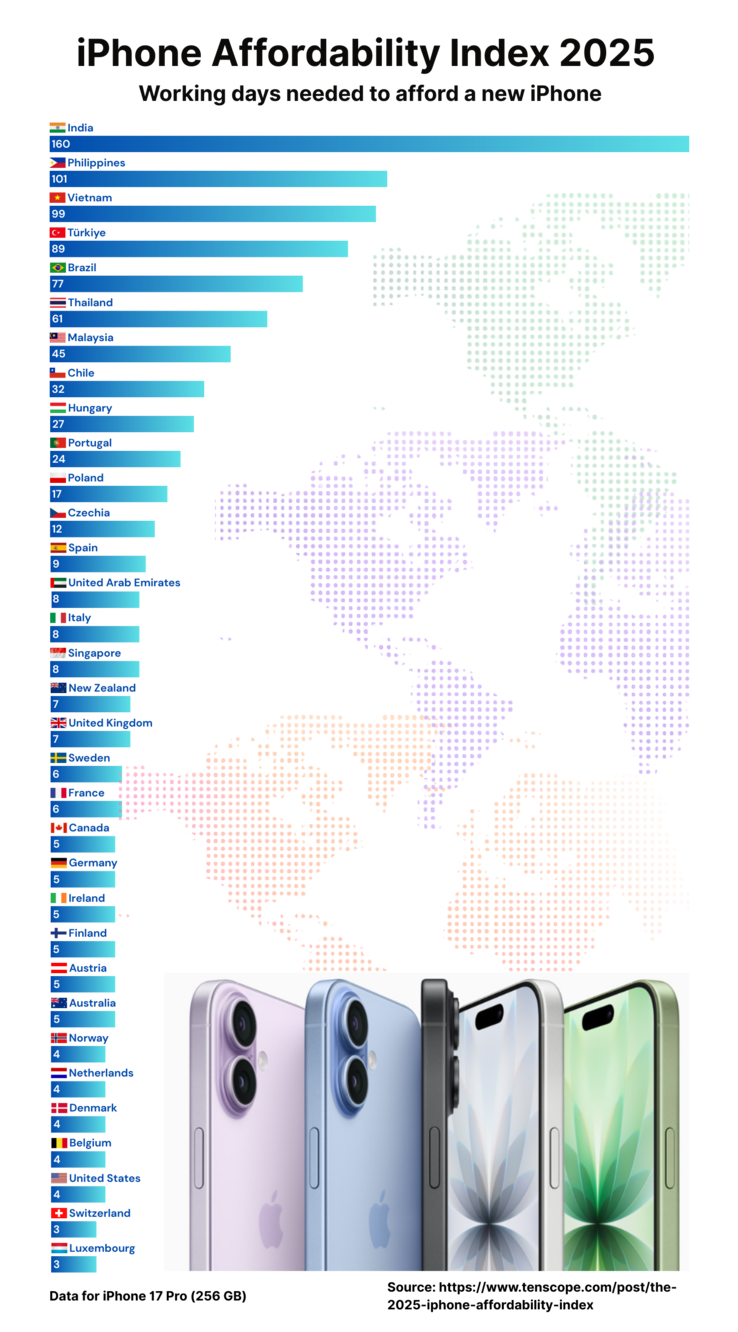
The iPhone is more than just a phone. For many people, it’s a status symbol, a tool for work and study, and a gateway to the digital world. But buying an iPhone is not easy for everyone. In some countries, the cost of the newest model equals many months—or even years—of salary. In others, it’s much more affordable. The iPhone Affordability Index is a way to understand these differences.
This index looks at how much of a person’s income is needed to buy an iPhone in different countries. It shows not only the price, but the real impact on people’s lives. If you’re curious about global tech trends, social inequality, or just want to know where the iPhone is easiest to buy, this article is for you.
We’ll explain what the index is, how it’s calculated, and what it reveals about the world today. You’ll also see practical examples, key data, and surprising facts that most people miss.
What Is The Iphone Affordability Index?
The iPhone Affordability Index is a number that helps compare how easy it is to buy an iPhone in different places. It’s not just about the price tag. Instead, it looks at the price as a share of the average income. For example, if the iPhone costs $1,000 and the average monthly salary is $2,000, the index is 0.5 (or 50%). If the salary is only $500, the index is 2 (or 200%). A higher index means the iPhone is less affordable.
This index is important because it gives a clearer picture than just price alone. In some countries, the iPhone may cost less in dollars, but local salaries are even lower. In others, the price is high, but so is the income.
The index helps us see the real challenge.
How The Index Is Calculated
To calculate the iPhone Affordability Index, you need:
- The local price of the latest iPhone model (usually the base model)
- The average monthly salary in that country
Divide the price by the salary. The result shows how many months of work are needed to buy the phone.
Example:
- IPhone price: $1,200
- Average salary: $600/month
- Index: $1,200 / $600 = 2 (two months of salary)
You can also use the annual salary for a broader view. Some indexes use net income (after taxes), others use gross income (before taxes). The most useful index is based on net income, since that’s what people actually receive.
Why The Index Matters
The iPhone Affordability Index is useful for several reasons:
- It shows economic inequality
- It helps tech companies understand their markets
- It guides buyers and families planning big purchases
- It reveals hidden challenges in developing countries
Many people think about price alone, but affordability is much more complex.
Global Iphone Prices: How They Differ
The price of an iPhone is not the same everywhere. Taxes, import fees, currency changes, and local demand all affect the final cost. For example, in the US, the iPhone 15 (base model) starts at $799. In Brazil, the same phone can cost over $1,500.
Why?
Reasons For Price Differences
- Taxes and Import Duties: Many countries add heavy taxes to imported electronics. In Brazil, these taxes can double the price.
- Currency Exchange Rates: If the local currency is weak against the US dollar, prices go up.
- Local Market Costs: Apple sometimes sets higher prices for markets with less competition or higher costs.
- Distribution and Retail Fees: In some countries, stores and distributors add extra fees.
Real Data: Comparing Global Prices
Here’s a look at the base price for the iPhone 15 (as of early 2024):
| Country | iPhone 15 Price (USD) | Notes |
|---|---|---|
| United States | 799 | Lowest official price |
| Japan | 880 | Includes local tax |
| India | 1,000 | High import duties |
| Brazil | 1,500 | Highest price worldwide |
| Germany | 950 | Includes VAT |
| South Africa | 1,050 | Includes import fees |
This shows a huge gap. Even before considering income, the price alone is very different.
Income Levels: The Other Half Of The Story
Price is just one side. The other side is average income. In the US, average monthly salary is around $4,000. In Brazil, it’s about $650. In India, it’s $220. These numbers change a lot.
Comparing Affordability
Let’s combine price and income to see the real picture. Here’s a simple comparison:
| Country | iPhone 15 Price (USD) | Average Monthly Salary (USD) | Months to Buy |
|---|---|---|---|
| United States | 799 | 4,000 | 0.2 |
| Germany | 950 | 3,200 | 0.3 |
| India | 1,000 | 220 | 4.5 |
| Brazil | 1,500 | 650 | 2.3 |
| South Africa | 1,050 | 490 | 2.1 |
In the US, the iPhone is less than a week’s salary. In India, it’s over four months. This is what the iPhone Affordability Index shows.
The Index In Practice: What It Reveals
Looking at the numbers, some patterns become clear. The iPhone is much easier to buy in richer countries. In poorer countries, it’s a luxury item. This affects many things: who buys iPhones, how they are used, and even social trends.
The Most Affordable Countries
The iPhone is easiest to buy in:
- United States
- Canada
- Australia
- Singapore
- Switzerland
These countries have high incomes and relatively low iPhone prices. People can buy the latest model with less than a week’s salary.
The Least Affordable Countries
The iPhone is hardest to buy in:
- India
- Brazil
- Turkey
- Egypt
- Nigeria
Here, the index is between 2 and 6 months of salary, sometimes more. For many families, buying an iPhone means saving for a long time, or not buying at all.
Hidden Insights: What Most People Miss
The iPhone Affordability Index shows things that are not obvious:
- Used iPhone Market: In less affordable countries, the used iPhone market is huge. People buy older models, or refurbished devices, because new ones are out of reach.
- Financing and Installments: In places where the iPhone is expensive, sellers offer payment plans. Sometimes, buyers pay for a phone over 12–24 months. This makes the index less visible, but the real cost is still high.
- Social Status: In some countries, owning an iPhone is a sign of wealth. People may spend more than they can afford, just to have the latest model. This can lead to debt or financial stress.
- Tech Adoption: Where iPhones are less affordable, Android phones dominate. They are cheaper, and more people can buy them.
- Government Policy: Sometimes, governments set high taxes to protect local industries. This can make iPhones very expensive, but it also shapes the tech landscape.
These insights are easy to miss if you only look at price or sales data.
Historical Trends: How The Index Has Changed
The iPhone Affordability Index is not fixed. It changes over time, depending on:
- IPhone price changes
- Local salary growth
- Currency exchange rates
- Tax and import rules
For example, in India, the index has gone up and down as salaries rise and prices change. In Brazil, currency devaluation has made iPhones more expensive, even as salaries improved. In the US, prices have stayed steady, but salaries have grown, making iPhones more affordable.
Example: Index Changes Over Time
Let’s look at how the index changed in three countries from 2015 to 2024.
| Year | United States | India | Brazil |
|---|---|---|---|
| 2015 | 0.25 | 5.2 | 2.8 |
| 2018 | 0.22 | 4.8 | 2.5 |
| 2020 | 0.21 | 4.9 | 2.6 |
| 2024 | 0.20 | 4.5 | 2.3 |
In the US, iPhones are slightly more affordable now than in 2015. In India and Brazil, they are still a big challenge, but slowly improving.
Iphone Affordability And Social Impact
The index is more than numbers. It affects real lives.
Education And Work
In many countries, smartphones are essential for education and work. Students need them for online classes, research, and communication. Workers use them for email, scheduling, and remote jobs. If the iPhone is not affordable, people may miss opportunities.
Android phones fill this gap, but they may lack some features. In some cases, teachers and employers prefer iPhones for their security and reliability. This puts extra pressure on families.
Digital Inclusion
The iPhone Affordability Index is a measure of digital inclusion. Where the index is high, fewer people have access to high-end technology. This can widen the gap between rich and poor, urban and rural, connected and disconnected.
Local Solutions
Some countries have tried to fix this gap:
- Encouraging local smartphone brands (India, China)
- Reducing import taxes (Turkey, South Africa)
- Promoting refurbished phones (Brazil, Egypt)
These solutions help, but the index shows the real challenge.
How Buyers Respond: Tips And Strategies
When the iPhone is hard to afford, buyers get creative. Here are some common strategies:
- Buy Older Models: Many people choose the iPhone 13 or 14 instead of the latest model. These are cheaper, but still good.
- Use Installment Plans: Paying monthly makes the cost easier to manage. But watch for high interest rates.
- Buy Refurbished: Certified used iPhones are much cheaper, and often just as good.
- Choose Android: If the iPhone is out of reach, Android phones offer many features at lower prices.
- Wait for Discounts: Some countries have seasonal sales or promotions. Waiting can save money.
One insight most beginners miss: Sometimes, buying a used iPhone from abroad (using online shops or friends) is cheaper than buying locally, even after shipping. But this can be risky, so check warranty and compatibility.
Comparing Iphone Affordability With Other Phones
The iPhone is not alone. Samsung, Xiaomi, Oppo, and other brands compete in the market. Their prices and affordability index are often much lower.
Example Comparison
Let’s compare the iPhone 15 with Samsung Galaxy S23 in India:
- IPhone 15: $1,000, affordability index = 4.5
- Samsung Galaxy S23: $700, affordability index = 3.2
The Samsung phone is easier to buy, even though it’s still expensive. In many countries, Android phones dominate because of affordability.
Factors That Affect The Index
Many things change the iPhone Affordability Index:
Economic Factors
- Salary growth: If average income rises, the index improves.
- Inflation: If prices rise faster than income, the index gets worse.
- Currency changes: If the local currency drops, imported phones cost more.
Policy Factors
- Tax changes: Lowering import taxes reduces price, improves index.
- Local manufacturing: If iPhones are made locally, prices may drop.
Market Factors
- Competition: If more brands enter the market, Apple may lower prices.
- Demand: High demand can push prices up, especially in smaller markets.
Social Factors
- Trends: If the iPhone becomes a must-have, people may pay more than they can afford.
- Peer pressure: In schools and workplaces, having an iPhone may be expected.
These factors are always changing, so the index is not fixed.

Practical Uses Of The Iphone Affordability Index
The index is not just for research. It has practical uses:
- For buyers: Helps decide if the iPhone is worth the cost
- For companies: Guides pricing and marketing strategy
- For governments: Shows digital inclusion gaps, helps set policy
- For researchers: Measures economic inequality and tech access
One insight: The index can also show how quickly technology spreads. In countries where the index drops (phones become more affordable), adoption rates go up.
Common Mistakes In Understanding The Index
Beginners often make mistakes when looking at the iPhone Affordability Index:
- Ignoring net income: Using gross income makes the index look better than it is. Always use net income.
- Forgetting hidden costs: Sometimes, taxes, shipping, or accessories add to the real price. Include these in your calculation.
- Assuming everyone earns the average: In many countries, income varies a lot. The index is just a guide, not a rule.
- Overlooking used and payment options: The index looks at new phones, but used phones and installment plans can change real affordability.
- Comparing only price: Always look at both price and income. Otherwise, you miss the full picture.
The Future Of The Iphone Affordability Index
As technology changes, so does the index. Several trends may shape the future:
- Local manufacturing: If Apple builds more phones in India, China, or Brazil, prices may drop.
- New payment models: Subscription phones, rental programs, and trade-in deals may change how people buy.
- Government policy: Efforts to reduce digital inequality may lower taxes or support cheaper devices.
- Changing economies: If incomes rise, the index improves. If currencies drop, it gets worse.
- Secondhand market growth: As more people buy used phones, the real index may improve, even if new phone prices stay high.
Another insight: In some places, the index is becoming less important as people shift to multi-device life—using tablets, laptops, and smartwatches alongside phones. Affordability is about the whole ecosystem, not just one device.
Frequently Asked Questions
What Is The Iphone Affordability Index?
The iPhone Affordability Index shows how much of a person’s income is needed to buy an iPhone in different countries. It’s calculated by dividing the local price by the average salary. This helps compare real buying power, not just price.
Why Are Iphones More Expensive In Some Countries?
Several factors affect price: import taxes, currency exchange rates, local market fees, and distribution costs. Some governments add high taxes to protect local industry, making iPhones much more expensive.
How Can I Improve My Iphone Affordability?
You can buy older or used models, use installment plans, look for discounts, or buy from abroad if possible. Comparing prices and payment options can help make the iPhone more affordable.
Does The Index Change For Different Iphone Models?
Yes. The index is usually calculated for the base model, but buying a Pro or Max model will raise the index. Used or older models will lower it. Always check which model the index uses.
Where Can I Find Official Data On Iphone Prices And Income?
For official iPhone prices, visit Apple’s local websites. For average income, use government statistics or trusted sources like the World Bank or Wikipedia. Always check for the latest numbers.
The iPhone Affordability Index helps us see the real cost of technology. It’s a tool for understanding not just price, but opportunity, inclusion, and economic challenge. Whether you’re a buyer, a policy maker, or just curious, this index is worth watching as the world changes.